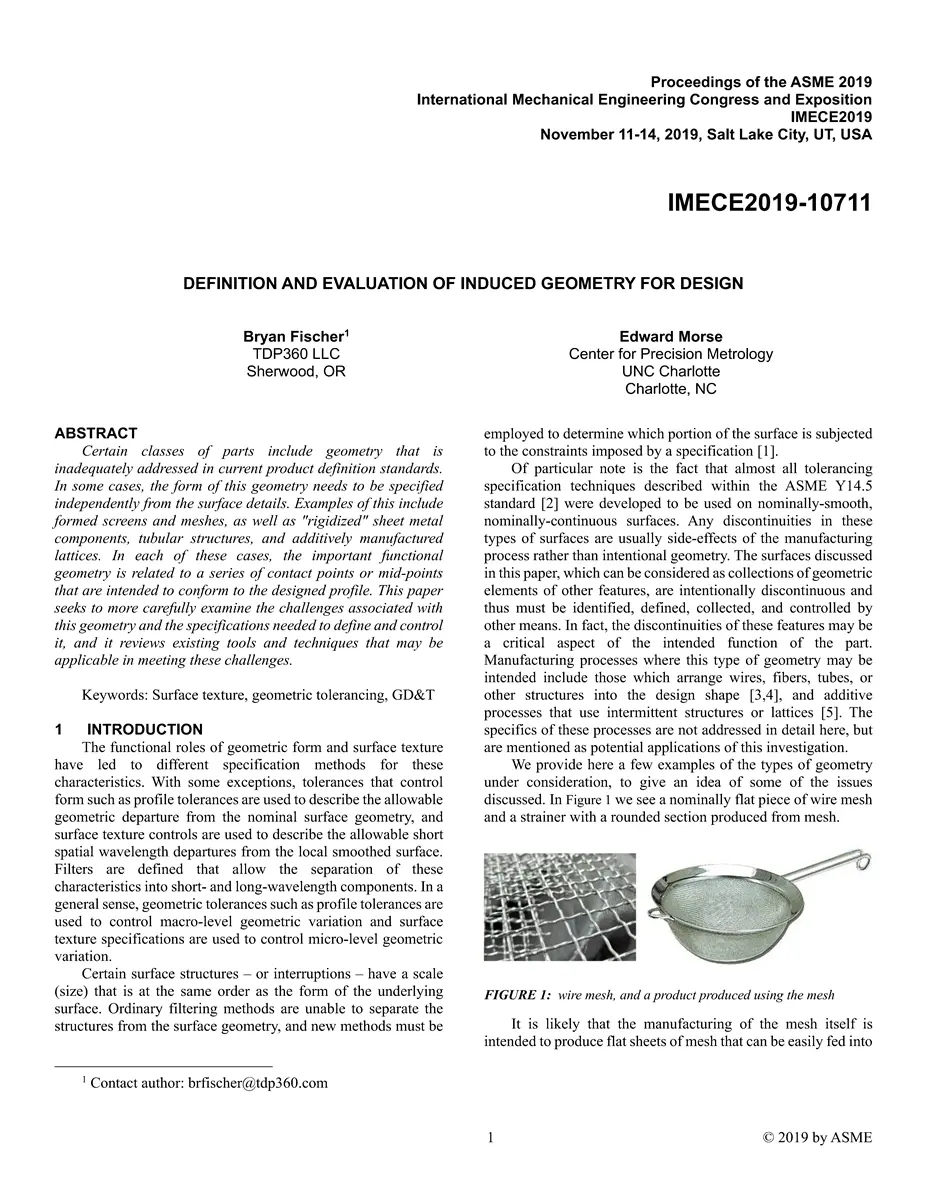
Early in my career I designed food processing machinery. Some products were made from stainless steel wire mesh formed into cones, corrugations, and other shapes. Many years later, working in automotive interiors, I applied GD&T to surfaces that are intentionally textured, such as leather, brushed, and other textures intended to attenuate sound and provide a luxurious appearance. I have worked with many other types of highly-interrupted surfaces, such as sintered parts, dimpled sheet metal, welded structures, fabrics, etc. Finally, the porous structures possible with 3D printing led me to identify a class of features that are underserved in GD&T and GPS.
GD&T and ISO GPS were developed for use on nominally smooth contiguous surfaces, such as a machined or sheet metal surface. They were not developed to work with intentionally porous surfaces or surfaces composed of a collection of tangent points, such as on formed wire mesh. In this paper, Edward Morse and I dive deeper into the challenges of specifying geometric tolerances on these surfaces and verifying conformance to the tolerances.
Fischer, Bryan; Morse, Edward; ASME, Journal for the ASME 2019 International Mechanical Engineering Congress and Exposition, 2020;
Abstract: Certain classes of parts include geometry that is inadequately addressed in current product definition standards. In some cases, the form of this geometry needs to be specified independently from the surface details. Examples of this include formed screens and meshes, as well as “rigidized” sheet metal components, tubular structures, and additively manufactured lattices. In each of these cases, the important functional geometry is related to a series of contact points or mid-points that are intended to conform to the designed profile. This paper seeks to more carefully examine the challenges associated with this geometry and the specifications needed to define and control it, and it reviews existing tools and techniques that may be applicable in meeting these challenges.